
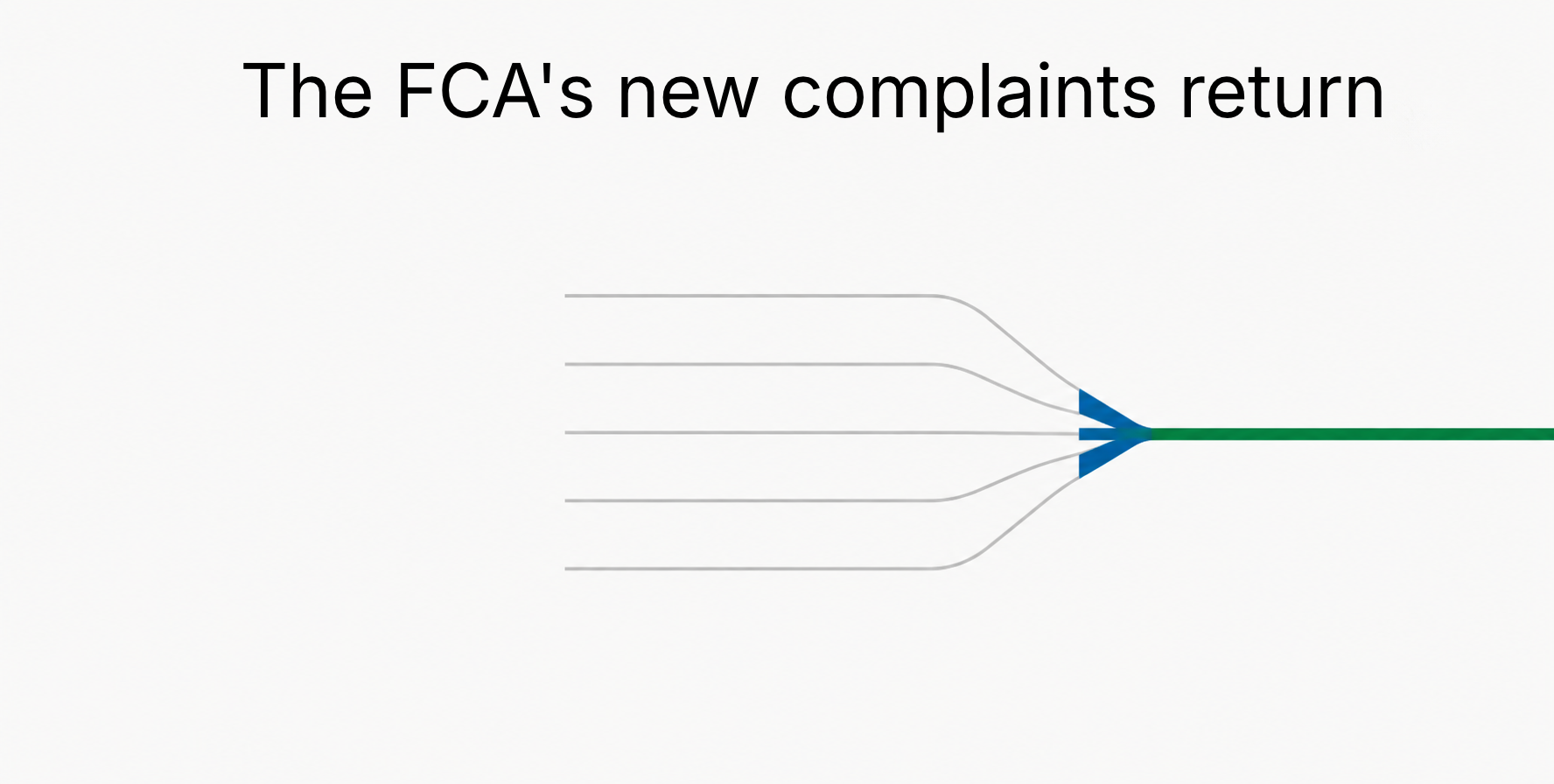
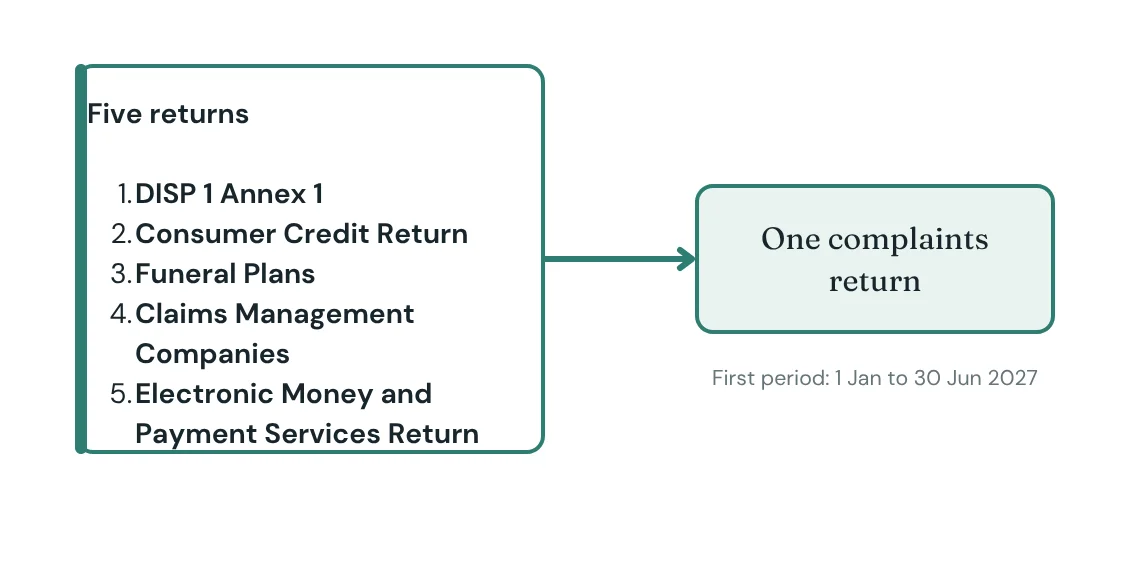
From the reporting period starting 1 January 2027, firms will file complaint data on a single return. The FCA's policy statement PS25/19 replaces five separate returns, including the Electronic Money and Payment Services Return that many fintechs file today.
Most commentary will cover what changes on the form. I want to cover what has to be true in your operation for the form to be right.
What changes?
- One return instead of five. Firms complete only the sections that match their permissions.
- Reporting is at the individual firm level. Group-level reporting goes.
- The product and complaint categories are revised.
- Firms report two vulnerability data points: customers identified as vulnerable and complaints caused by a failure to consider or respond to vulnerability.
- Reporting periods are fixed: six-monthly and calendar-year. The first runs from 1 January to 30 June 2027.
- The FCA will publish firm-level data for firms with 500 or more complaints.
Where the work really is
A return is only as good as the complaint record behind it. Three weaknesses commonly undermine complaint data.
- Categories are chosen by whoever opens the case. Two agents classify the same complaint differently, so the totals move for reasons unrelated to customers.
- The complaint is split across systems. The first contact sits in the support tool, the investigation in a spreadsheet and the outcome in the CRM. Nobody can follow one complaint from start to finish.
- Vulnerability is a free-text note. If it is not a field, it cannot be counted, and you cannot show that you responded to it.
A practical test
Pick twenty closed complaints at random. For each, can someone other than the handler tell, in under five minutes, when it arrived, how it was categorised, who touched it, whether the customer was flagged as vulnerable and how it was resolved? If the answer is no for more than a few, the return will be hard to produce and harder to defend.
What I would do in the next six weeks
- Agree one category list and one owner for it.
- Make vulnerability a required field, not a note.
- Reconstruct the end-to-end path of a sample of complaints from event data in your systems, so you can see where cases are re-opened or handed over.
- Run a dry-run return on the last six months and compare it with what your management information says.
That last step is where process intelligence earns its place. It shows how complaints really move, not how the procedure says they should.
If you would like to see what that looks like on a sample, my sample root cause report uses synthetic data and takes five minutes to read.
Source: FCA PS25/19: Improving the complaints reporting process
Discussion
0 contributionsPlease sign in or create a verified account to join the discussion.
No comments yet. Be the first to share your perspective!